Formation Dynamics: Contrasting Winning Line Development in 75-Ball and 90-Ball Bingo
Ellis Beck · Nov 19, 2026
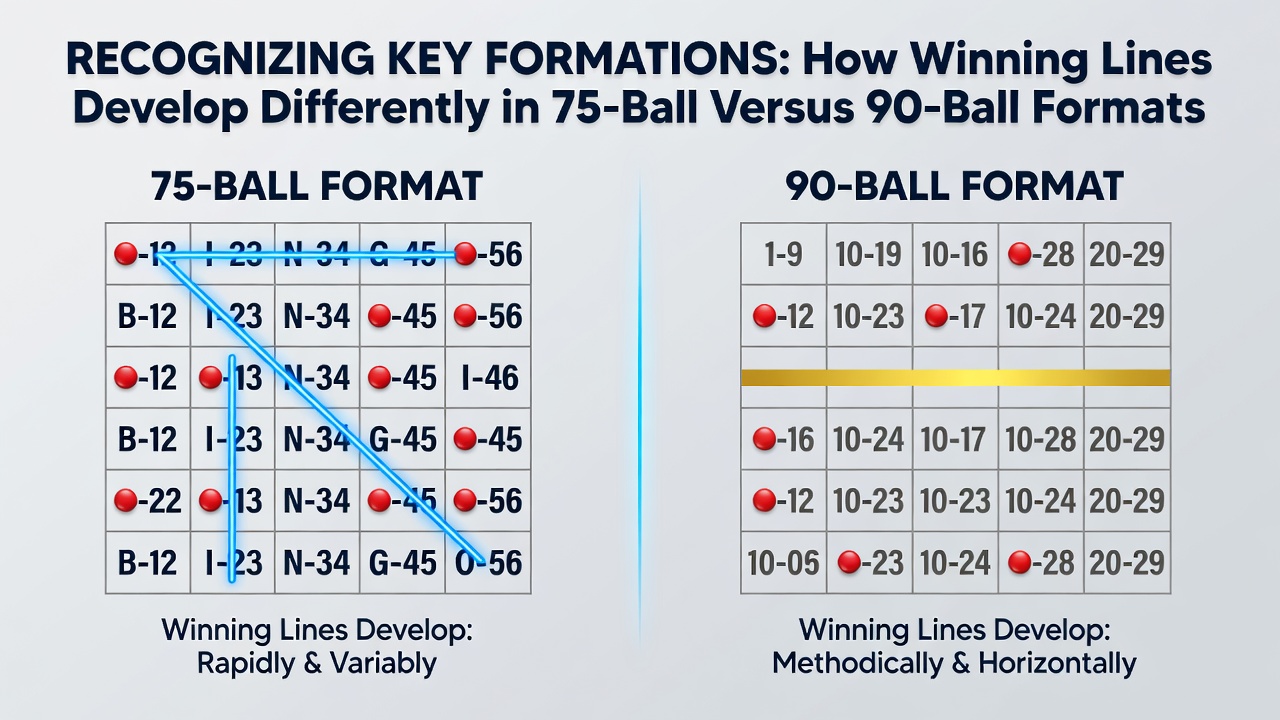
Formation Dynamics: Contrasting Winning Line Development in 75-Ball and 90-Ball Bingo
Players encounter distinct grid architectures when they sit down to 75-ball versus 90-ball bingo, and those architectures dictate how winning lines emerge over the course of a game. The 75-ball format uses a five-by-five grid with a free space in the center, while the 90-ball version relies on a three-row, nine-column ticket that leaves many cells blank. Observers note that these structural differences shape the speed and variety of line completions, and data collected across multiple jurisdictions shows measurable variation in the number of calls required before patterns resolve.
Grid Architecture and Pattern Possibilities
The five-by-five layout in 75-ball bingo permits horizontal, vertical, and diagonal lines as well as more elaborate shapes such as four corners or full blackout. Each drawn number can advance multiple potential lines simultaneously because every column is headed by a letter from the B-I-N-G-O set, and numbers fall within fixed ranges. In contrast, 90-ball tickets contain only fifteen numbers spread across three rows, so a winning line must occupy an entire horizontal row of five numbers. This constraint limits pattern diversity yet creates a clear progression from one-line wins to two-line wins and finally to the full-house outcome. Researchers tracking session data in regulated markets have recorded that 75-ball games often conclude after fewer than fifty calls when standard line patterns are in play, whereas 90-ball sessions frequently extend beyond sixty calls before a full house appears.
Number Distribution and Line Completion Rates
Number distribution further separates the two formats. In 75-ball play, the twenty-four active cells receive numbers from one to seventy-five in a randomized distribution, which means each new call has a high probability of intersecting several open lines at once. Analysts examining records maintained by the North American Association of State and Provincial Lotteries found that diagonal lines in 75-ball games reach completion roughly twenty percent faster than vertical lines because the center free space reduces the required matches by one. The 90-ball ticket, however, groups numbers into tens within each column, and players must cover five numbers per row without the benefit of a free space. Consequently, the first row to fill tends to appear later in the sequence of draws, and statistical models indicate that the median call count for a single-line win sits near forty-five draws.
Strategic Implications for Pattern Recognition
Participants who study formation timing adjust their attention differently depending on the variant. In 75-ball sessions, attention often shifts among several candidate patterns as each number lands, since one call can complete a horizontal line while simultaneously advancing a diagonal. The 90-ball format encourages sequential focus: players mark the first line, then monitor remaining rows for the second-line stage, and finally track the full house. Industry reports compiled by the Australian Communications and Media Authority illustrate that these differing cognitive demands produce measurable differences in average session length, with 90-ball games running longer on average because players must wait for three separate milestones rather than a single flexible pattern.
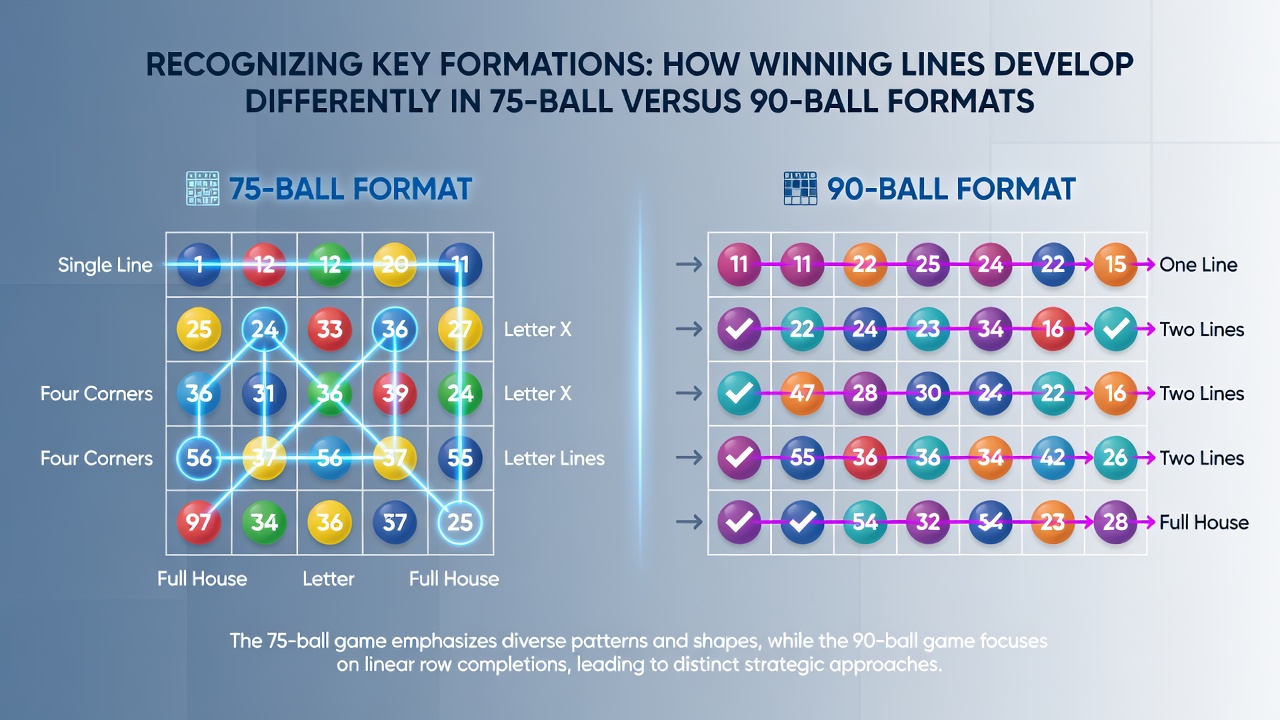
As of November 2026, digital platforms continue to offer both formats side by side, and backend analytics reveal that players frequently switch between them within the same sitting. The switch requires recalibration of pattern expectations: what counts as a viable line in one variant does not translate directly to the other. Those who track their own results note that 75-ball games reward rapid scanning of the entire grid, while 90-ball games reward methodical row-by-row verification. Mathematical simulations published in peer-reviewed gaming studies confirm that the probability curves for each format diverge sharply after the thirtieth call, with 75-ball line probabilities rising steeply and 90-ball probabilities remaining more linear until the later stages.
Regional Variations in Format Popularity
Geographic preferences also influence which formation styles dominate. Markets in parts of Europe and Canada show higher volumes of 90-ball play, where the tiered one-line, two-line, full-house structure aligns with established prize ladders. North American venues lean toward 75-ball because the variety of patterns supports larger progressive jackpots and special-event games. Data aggregated by the Canadian Gaming Association indicates that the median number of calls needed to complete a blackout pattern in 75-ball exceeds seventy, a figure that exceeds the typical full-house threshold in 90-ball yet attracts players seeking extended sessions and escalating prize pools.
Conclusion
The architectural distinctions between five-by-five and three-by-nine grids produce reliably different trajectories for winning-line development. Number ranges, free-space placement, and permitted patterns combine to create measurable differences in call counts, cognitive demands, and regional adoption rates. Observers monitoring platform statistics through late 2026 continue to record these consistent patterns across regulated environments, confirming that format choice directly shapes how and when lines reach completion.